The Lush Lawn Illusion (Without a Single Blade of Grass)
Here’s a secret landscape designers will tell you over coffee: the greenest-looking yards in the neighborhood often contain no grass at all. Between water bills, mowing, and brown summer patches, the traditional lawn is falling out of favor — and designers have quietly perfected the art of the grass-free yard that looks more lush than the lawns around it.
Whether you’re dealing with shade, drought, HOA water restrictions, or just lawn fatigue, here’s exactly how the pros make grass-free front yards look abundant and alive.
Secret #1: Think in Masses, Not Specimens
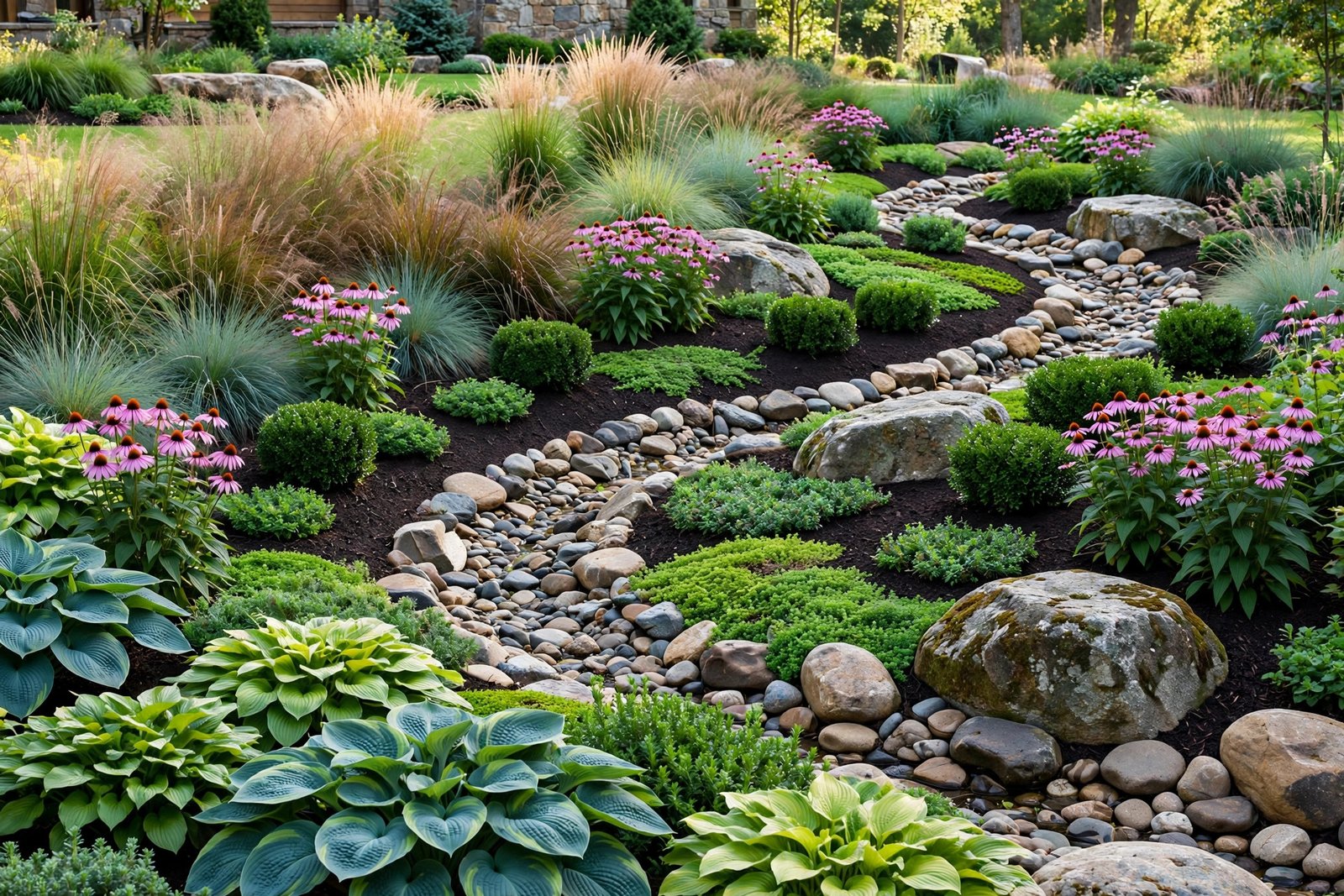
The #1 mistake in grass-free yards is planting “one of everything” — it looks like a botanical garden gift shop. Designers plant in drifts and masses: sweeps of the same plant repeated across the bed. Five ornamental grasses together read as lush; five different plants spaced apart read as sparse. Rule of thumb: buy plants in odd-numbered groups (3, 5, 7) and repeat those groups.
Secret #2: Layer Like a Forest
Walk through a forest and notice the structure: canopy trees, understory shrubs, ground-level plants. Lushness is vertical as much as it is green. Recreate it:
- Top layer (4–8 ft): small ornamental trees or large shrubs — Japanese maple, crape myrtle, large grasses
- Middle layer (2–4 ft): mounding shrubs — hydrangea, boxwood, lavender, mid-size grasses
- Ground layer (under 2 ft): groundcovers that knit together — creeping thyme, sedum, mondo grass, liriope
When every vertical inch is occupied, the eye reads “abundance” — the exact opposite of a flat lawn.
Secret #3: The 70/30 Evergreen Rule
A yard looks lush in December for one reason: evergreens. Designers aim for roughly 70% evergreen structure (plants that hold leaves year-round) and 30% seasonal stars. The evergreens — boxwood, holly, yew, evergreen grasses like carex — are the “bones” that keep the yard looking full when perennials die back. Without them, grass-free yards look empty half the year.
Secret #4: Texture Beats Color
Here’s the real pro secret: lushness is mostly about texture contrast, not flowers. Combine:
- Fine texture (ornamental grasses, ferns, threadleaf plants)
- Medium texture (most shrubs and perennials)
- Bold texture (hostas, ligularia, large-leaf plants)
Place fine next to bold and both look more dramatic. A yard of all medium-texture plants looks flat even when it’s packed. This single principle separates amateur plantings from designer ones.
Secret #5: Mulch Like You Mean It
Professional installations use a thick, uniform 3-inch layer of dark mulch — and it does half the visual work. Dark mulch makes every green pop, hides soil, suppresses weeds, and gives the crisp “finished” edge that reads as expensive. Shredded bark or pine straw both work; the key is one type throughout, not a patchwork.
Secret #6: Curves, Not Rectangles
Lawns are rectangles; designer beds are curves. Sweeping, generous curves in your bed edges instantly signal “professionally designed.” Use a garden hose to lay out the curve on the ground before you dig — step back and look from the street. Bigger, bolder curves almost always look better than timid wiggles.
Secret #7: The Power of Repetition
Pick 5–7 plant varieties total and repeat them. That’s it. A front yard with 200 plants of 6 varieties looks designed; a yard with 40 plants of 30 varieties looks like a clearance sale. Restraint is the most expensive-looking thing in landscaping, and it’s free.
Secret #8: Hardscape as Design, Not Filler
Grass-free doesn’t mean plant-only. Designers use gravel paths, stone borders, and boulders as intentional design elements:
- A dry creek bed of river rock winding through plantings looks sculptural and solves drainage
- Large boulders (even 2–3) anchor a bed like exclamation points
- Stepping stone paths with groundcover growing between the stones look straight out of a magazine
Secret #9: Light It Like a Stage
Landscape lighting isn’t just for lawns. A few well-placed uplights on trees and architectural grasses make a grass-free yard look more dramatic at night than any lawn. Solar spotlights ($10–15 each) aimed up into ornamental grasses create stunning silhouettes.
Secret #10: Edge Everything
Crisp edges are the difference between “wildflower meadow” and “designer garden.” A clean spade-cut edge or steel edging between beds and paths signals intention. It’s the cheapest upgrade on this list and one of the most impactful.
Putting It Together: A Sample Plant Palette
For a sunny front yard (adjust for your zone):
- Anchors: 3 ornamental grasses (miscanthus or pennisetum), 1 small crape myrtle
- Structure: 5 boxwood or inkberry holly (evergreen bones)
- Seasonal stars: 7 echinacea, 5 salvia, 5 coreopsis
- Groundcover: creeping thyme or sedum to knit it all together
- Finish: 3 inches of dark shredded bark mulch, curved bed edge
That’s a complete designer-looking front yard — no grass required.
Frequently Asked Questions
Will a grass-free yard hurt my home’s resale value?
In most markets, no — well-designed grass-free landscaping appraises as well as or better than lawn, especially in drought-prone regions. The key word is designed: intentional beds with clean edges read as an upgrade, while a weedy dirt patch reads as neglect.
Is it really lower maintenance than a lawn?
Yes, dramatically. No mowing, no fertilizing schedule, far less water once established. Expect some weeding the first year while groundcovers fill in, then minimal upkeep — mostly seasonal pruning and mulch top-ups.
What about HOAs that require lawns?
Check your HOA rules carefully — many now allow “water-wise” alternatives, and some states prohibit HOAs from mandating grass. If yours is strict, a compromise works: keep a small lawn panel as a “rug” surrounded by lush beds.
How much does converting cost?
A DIY conversion of an average front yard runs $500–1,500 in plants and mulch if you do the labor. Professional installation runs $3,000–8,000+. Start with one bed and expand — designers build great yards in phases all the time.
The Takeaway
Lush isn’t about grass — it’s about mass, layers, texture, and intention. Plant in drifts, layer vertically, lean on evergreens, contrast textures, mulch deeply, and edge crisply. Do that, and your grass-free yard won’t just keep up with the lawns on your street. It’ll make them look boring.